



It is a holiday for the crew, so I’m here all by myself. I spent 10 hours on the bulldozer pushing dirt around; clearing a greensite, a tee area and worked on some rough shaping.
Tony Ristola
agolfarchitect.com
+1 (909) 581 0080
Thursday, June 7, 2007
Wednesday, June 6, 2007
Lake Excavation Day 2
We were making pretty good progress with excavating the lake, a few times thundershowers looked like they would hit the construction site, but we got lucky… they passed by us. Luck wasn’t on our side the entire day though. As we were excavating the southern two-thirds of the lake (our total excavation area is about 140 meters by 40 meters) we hit a clay-like substance. It wasn’t water tight, as streams of water entered through the banks, eventually collapsing it and the pocket. Looks like we need a pump for further excavation on the south side.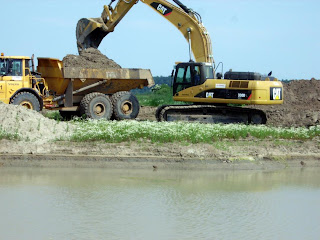
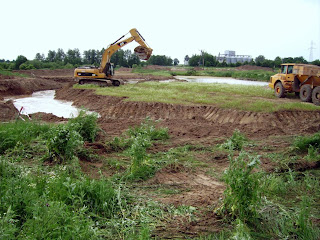

We have been digging the dirt out in pockets so it comes out relatively dry, otherwise we would be hauling out pudding. When a pocket is excavated, its walls are torn down to irregular heights. When finished, the water feature should have irregular streaks of vegetation growing from it; ideal habitat for birds and other aquatic wildlife, while adding to its beauty.
Tony Ristola
agolfarchitect.com
+1 (909) 581 0080


We have been digging the dirt out in pockets so it comes out relatively dry, otherwise we would be hauling out pudding. When a pocket is excavated, its walls are torn down to irregular heights. When finished, the water feature should have irregular streaks of vegetation growing from it; ideal habitat for birds and other aquatic wildlife, while adding to its beauty.
Tony Ristola
agolfarchitect.com
+1 (909) 581 0080

Tuesday, June 5, 2007
Lake Excavation Day 1
This is our first full day at excavating the remainder of the lake. The start, less than half the excavation was completed by the previous construction company, and they left us with a couple challenges.
1. All the water bordering our excavation and…
2. They did not dig to the prescribed depth. Our side of the pond must make up for this deficiency.
The day went well, the hauls are short, and the material and weather cooperative.

To the left of the water is a short, brighter green vegeatation where the topsoil has been removed. This entire section need be excavated to bring the water feature to its full size; about 150 meters by 40 meters by 2.5 meters deep.
Tony Ristola
agolfarchitect.com
+1 (909) 581 0080
1. All the water bordering our excavation and…
2. They did not dig to the prescribed depth. Our side of the pond must make up for this deficiency.
The day went well, the hauls are short, and the material and weather cooperative.

To the left of the water is a short, brighter green vegeatation where the topsoil has been removed. This entire section need be excavated to bring the water feature to its full size; about 150 meters by 40 meters by 2.5 meters deep.
Tony Ristola
agolfarchitect.com
+1 (909) 581 0080
Monday, June 4, 2007
Moving Masses

Today we put the Caterpillar 330 to work with two Volvo Dumpers. They made quick work of a 60 meter by 5 meter by 1.5 meter wall of topsoil. Then it was off to the lake to start the excavation. The photo shows the operator discussing the upcoming lake work.
Tony Ristola
agolfarchitect.com
+1 (909) 581 0080
Sunday, June 3, 2007
We Were Going to Pull Off a Destroyed Dyke Wall Concept
We were going to pull off a destroyed Dyke Wall concept for this hole, meandering it through the fairway; plausible given the rail line that runs parallel to the hole. The more we think about it, seize opportunities (that’s how the Dyke Wall concept started), and try to solve challenges, the evolution continues. Now we are looking at putting a “Dune” to the right of the green to reduce noise from the highway (to be moved in the near future) and utilize inferior fill left behind from the previous builder. With this idea, the “Dike Concept” is no longer believable, but a river dunes concept is. One benefit; the new version of Hole 6 allows us to introduce a bit of rolling character to a few of the other low lying holes along the river.
Having built another project along a protected area hard by river dunes I’ve made a close study of them. Our new concept is 100% believable... we just have to do it right, embrace randomness, maximize the drama and be sure to create dunes with a variety of heights, rawness (now is not the time for smooth, dome-shaped piles) and character.
Tony Ristola
agolfarchitect.com
+1 (909) 581 0080
Having built another project along a protected area hard by river dunes I’ve made a close study of them. Our new concept is 100% believable... we just have to do it right, embrace randomness, maximize the drama and be sure to create dunes with a variety of heights, rawness (now is not the time for smooth, dome-shaped piles) and character.
Tony Ristola
agolfarchitect.com
+1 (909) 581 0080
Saturday, June 2, 2007
For Our Lake Excavation

For our lake excavation and to rip out sand from the quarry for filling fairways, green and tee pads, we have just accepted delivery of a 30+ ton Caterpillar 330, that’s more than 10 tons heavier than our Volvo EC210lc. The bucket can rip out 2.5 cubic meters at a time. For those that can’t grasp that, it means a small adult could just about sleep in the bucket. To keep it busy, it will be feeding 3 dumpers capable of hauling about 30 cubic meters at a time, plus one smaller dumper.
Tony Ristola
agolfarchitect.com
+1 (909) 581 0080
Friday, June 1, 2007
Hole 6; Field Changes
Adjusting to Get the Strategy-Playability-Aesthetics Right
Opportunities are a highly valuable raw material, present themselves everyday during construction, and cannot be measured if missed. That’s why many of the great courses were the first by the architect, or done early in their career. Their time wasn’t divided by multiple projects…so they had the time to seize every opportunity. They maximized the use of this valuable raw material.
The 6th Hole is undergoing a transformation due to opportunities that were not foreseen during planning. Originally an open expanse of two fairways, we have chosen some concepts will improve the hole, reduce construction costs, and speed up the production of the hole (even though we have to truck in a meter thick layer of sand to cap about 300 meters (330 yards) by 55 meters (60 yards) of fairway).
What we will have now is a version of a Dyke Wall running diagonally through the hole. The green concept is also altered. Once a not so deep green tight to the dyke wall behind the will now be separated from it and the green lengthened. The deeper green will accept a longer bounced in approach. Between the back of the green and the dyke along the river will be a bunker to stop shots from bounding over the green and into long grass or the river.
Well, that’s where we stand now. As we build and are standing over construction, we have the flexibility of a speed boat…able to turn on a dime…see things from every angle, think about all the opportunities that occur every day of construction, and adjust when it is advantageous. And these changes are not isolated, as these facilitate changes to other holes in the vicinity.
Tony Ristola
agolfarchitect.com
+1 (909) 581 0080
Charlie Munger:
Mistakes of omission are the most troubling.
They show up as lost opportunity costs, and we are mistaken not to take advantage of these opportunities. What really cost are these blown opportunities.
Warren Buffett:
Errors of omission…can happen when we stand
and stare at an opportunity and do nothing with it. It is important to know the business and the opportunity because conventional accounting
does not identify lost opportunities.
Mistakes of omission are the most troubling.
They show up as lost opportunity costs, and we are mistaken not to take advantage of these opportunities. What really cost are these blown opportunities.
Warren Buffett:
Errors of omission…can happen when we stand
and stare at an opportunity and do nothing with it. It is important to know the business and the opportunity because conventional accounting
does not identify lost opportunities.
Berkshire Hathaway's Annual Stockholder Meeting
Saturday, April 28, 2001
Saturday, April 28, 2001
Opportunities are a highly valuable raw material, present themselves everyday during construction, and cannot be measured if missed. That’s why many of the great courses were the first by the architect, or done early in their career. Their time wasn’t divided by multiple projects…so they had the time to seize every opportunity. They maximized the use of this valuable raw material.
The 6th Hole is undergoing a transformation due to opportunities that were not foreseen during planning. Originally an open expanse of two fairways, we have chosen some concepts will improve the hole, reduce construction costs, and speed up the production of the hole (even though we have to truck in a meter thick layer of sand to cap about 300 meters (330 yards) by 55 meters (60 yards) of fairway).
What we will have now is a version of a Dyke Wall running diagonally through the hole. The green concept is also altered. Once a not so deep green tight to the dyke wall behind the will now be separated from it and the green lengthened. The deeper green will accept a longer bounced in approach. Between the back of the green and the dyke along the river will be a bunker to stop shots from bounding over the green and into long grass or the river.
Well, that’s where we stand now. As we build and are standing over construction, we have the flexibility of a speed boat…able to turn on a dime…see things from every angle, think about all the opportunities that occur every day of construction, and adjust when it is advantageous. And these changes are not isolated, as these facilitate changes to other holes in the vicinity.
Tony Ristola
agolfarchitect.com
+1 (909) 581 0080
Subscribe to:
Posts (Atom)